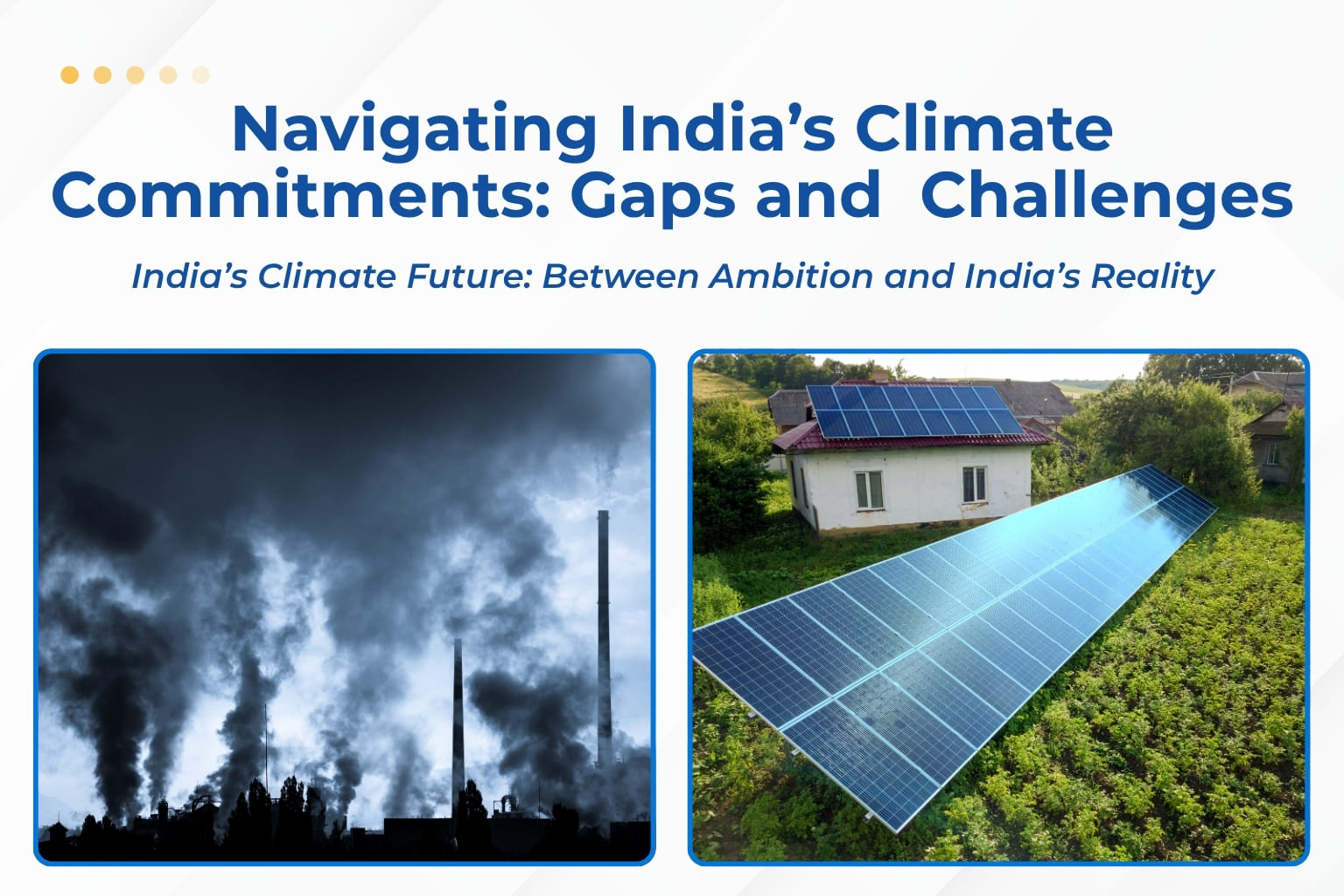
India’s Climate Future: Between Ambition and Reality
India’s climate future is caught between ambitious commitments and challenging realities. The IMF Working Paper titled “A Framework for Climate Change Mitigation in India” provides an extensive overview of India’s emissions landscape, current policy framework, and the macroeconomic trade-offs involved in reaching Net Zero by 2070. It’s not just data – it’s a wake-up call!
Where Does India Stand
India is the world’s third-largest emitter of GHG, yet it has one of the lowest per capita emissions in the G20. Under the current policies, emissions are projected to increase by 41% by 2030, even as the country is set to meet its Nationally Determined Contribution (NDC) target of reducing its emissions intensity by 45% from 2005 levels.
This paradox: economic growth vs emissions reduction is at the core of India’s climate dilemma.
Sector-Wise Highlights from IMF Analysis
Five high-impact sectors:
India is still heavily reliant on coal (72% of electricity generation). Although renewable energy capacity has grown, investment in it is only half of what is needed to meet 2030 targets. Financial distress in distribution companies (DISCOM’s) as well as challenges in the implementation of renewable energy certificates (REC) are hindering progress.
The energy sector accounts for 22% of emissions. Despite schemes like Perform, Achieve, and Trade (PAT) and Production-Linked Incentive (PLI), heavy industry remains dependent on fossil fuels. MSMEs need better access to energy-efficient tech and finance.
Currently, 97% of road transport relies on petrol or diesel, making the update of electric vehicles critical. While schemes like Faster Adoption and Manufacturing of (Hybrid and) Electric Vehicles (FAME) and railway electrification are in progress, freight transport and aviation are still largely overlooked.
The agricultural sector has been excluded from long-term climate strategies, despite contributing to 74% of India’s methane emissions. Although initiatives like PM-KUSUM aim to promote solarization, they are underfunded and face adoption barriers.
Solid biofuels are predominantly used in rural households. Programs like UJALA and Eco-Niwas Samhita work to improve energy efficiency, but scaling these efforts remains inconsistent.
Policy Gaps and Transition Costs
Macroeconomic modelling reveals that inaction is, in fact, costlier than transition. A modest 15% emission reduction by 2030, at a carbon price of $5 per ton of CO₂ equivalent, necessitates a combination of renewable energy subsidies, coal taxes, and a functional carbon market. Delaying change will deter the transition from fossil infrastructure and exacerbate health, financial and climate vulnerabilities.
Way Forward
To address these challenges India should:
Expand climate regulations beyond energy efficiency to ensure equitable transition pathways.
Implement a comprehensive, compliance-driven carbon market and define fiscal incentives with clear accountability across sectors.
Mobilize blended climate finance and technology to address the ambition-action gap.
India’s climate laws and policies must shift from fragmented efforts to a unified national decarbonization framework coupled with a comprehensive climate law. Climate change is accelerating, and the rights of 1.5 billion people depends on whether our laws and efforts rise to meet the challenge.
Discussion
What steps do you think India needs to take to meet its climate goals?
Contributed by: Prof. Dr. Tarini Mehta, GARP SCR® Divita Vashisht