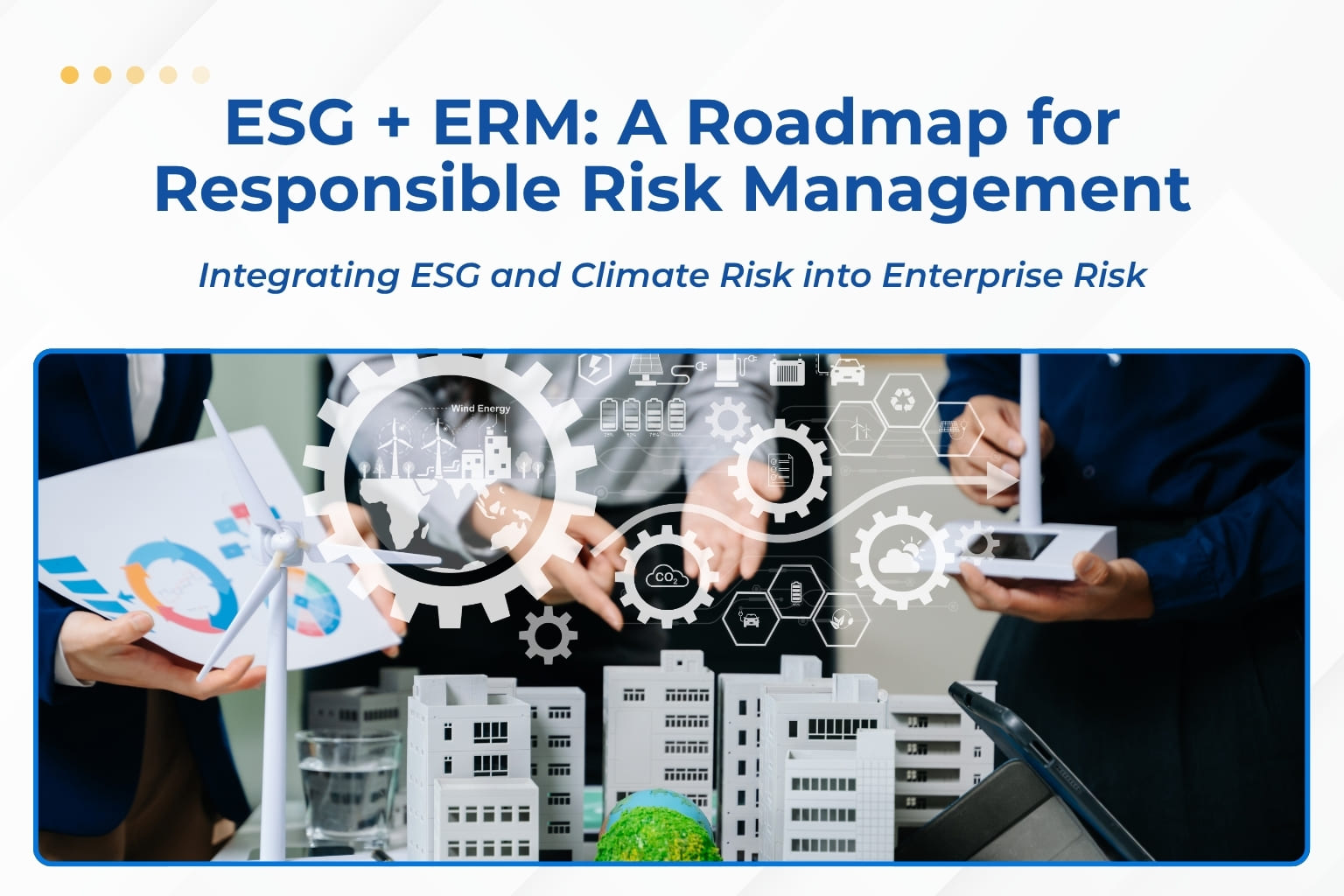
Integrating ESG and Climate Risk into Enterprise Risk Management (ERM)
As climate and ESG risk affects most traditional categories of risk, it is imperative that it be managed proactively. This can be done by integrating ESG and climate risk drivers into Enterprise Risk Management (ERM). This is not just good governance—it is a strategic necessity.
One of the most widely used ERM frameworks was developed by COSO (The Committee of Sponsoring Organisations of the Treadway Commission), which requires integration across five broad areas as per their latest 2017 version:
Governance
The board must actively oversee ESG-related risks, ensuring that ESG considerations are embedded into the organisation’s governance structure. Companies should demonstrate a commitment to core ESG values and ensure that skilled individuals are recruited and retained to manage evolving ESG risks effectively.
Strategy
The organisation should evaluate its external and internal business environment with ESG factors in mind, define its risk appetite for climate and sustainability-related issues, assess alternative business strategies based on ESG impacts, and establish ESG-aligned objectives that support long-term value creation.
Performance
ESG risks must be identified systematically across the value chain, their severity assessed and prioritised based on materiality. Companies should implement timely responses to these risks and develop an integrated ESG risk portfolio view to align risk exposure with enterprise goals.
Review
Companies should regularly assess substantial change in ESG, including regulatory, environmental, or social developments. ESG risk performance must be reviewed in light of these changes, and efforts should be made to continuously improve the enterprise risk management.
Communication
Companies should leverage data systems and technology to analyse ESG risk information, ensure transparent internal communication between departments, and report ESG risk culture and performance to stakeholders in alignment with global frameworks like ISSB, BRSR, and TCFD.
This depicts that climate risk measurement and management is possible and can be incorporated into standard enterprise risk management frameworks.
Key Measures for ESG-ERM Integration
Step 1: Establish Governance and Ownership
- Define clear responsibilities across risk, compliance, and sustainability teams.
- Engage the board and leadership in ESG risk oversight. Form a cross-functional ESG risk committee.
Step 2: Identify Material ESG Risks
- Conduct a double materiality assessment and map ESG-related risk drivers (for instance, physical, transition, litigation, reputational risks).
- Consider systemic, sectoral, and supply chain exposure.
- Align with global frameworks such as GRI, ISSB, SASB.
- Use materiality matrices to prioritize ESG risks.
- Conduct scenario analysis and stress testing for climate and social risks.
- Evaluate short-, medium-, and long-term implications.
Step 3: Integrate ESG into Risk Frameworks
- Embed ESG into risk registers, Key Performance Indicators (KPIs), and capital planning.
- Update internal controls, audit protocols, and risk appetite statements.
- Link ESG risks with KPIs and financial reporting.
- Embed ESG factors into enterprise risk registers, heat maps, and control systems.
- Update ERM policies to reflect ESG-specific risk categories (e.g. climate, human rights, biodiversity, supply chain ethics).
Step 4: Quantify and Prioritize Risks
- Apply scenario analysis, stress testing, and impact likelihood scoring for ESG-linked risks.
- Link ESG risk to financial materiality and strategic objectives.
Step 5: Monitor, Report & Improve
- Align ESG risk metrics with KPIs.
- Ensure disclosures meet global reporting standards (e.g. ISSB S1/S2, BRSR Core, CDP).
- Continuously refine processes based on internal audits, regulatory trends, and stakeholder feedback.
Why This Matters
- Anticipate long-term risks
- Build investor confidence
- Align sustainability with resilience
- Navigate policy, reputational, and climate-related exposure
ESG is not a separate lens—it is the new baseline for enterprise risk.
#ESG #ERM #RiskManagement #ClimateRisk #Sustainability #Governance #BRSR #ISSB #TCFD #ESGStrategy #BoardOversight #Materiality #ScenarioAnalysis #ESGIntegration